Red Light Bed ROI: How to Model Payback for Your Facility
A practical framework for gyms, hotels, spas and clinics to model red light bed payback with conservative, moderate and strong occupancy scenarios.
A practical framework for gyms, hotels, spas and clinics to model red light bed payback with conservative, moderate and strong occupancy scenarios.
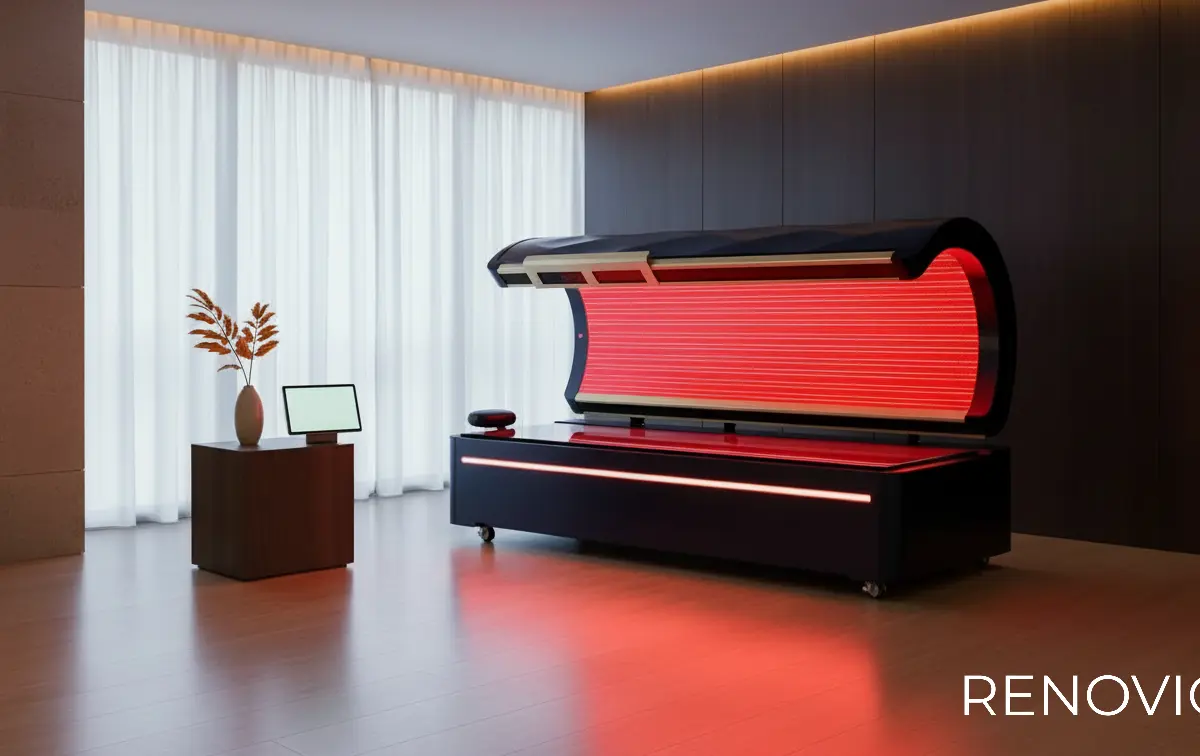
A Red Light bed is a capital purchase, so it should be tested like one. Before you commit, build a model on your own opening hours, your own pricing and your own footfall, not a generic payback claim. This guide gives gym, hotel, spa and clinic owners a practical framework to build that model and pressure-test it.
The figures that decide your result are yours. We have deliberately not put invented numbers in the examples below. Where a value is needed, use your own data or the specification in your quote.
Four inputs do most of the work in any payback model: price point, session length, occupancy and running costs.
Decide how the bed earns before you decide whether it does. The common routes are:
For each route, work from net revenue per session, after VAT, discounts and payment processing fees. Be consistent about whether your session price is quoted inc or ex VAT, because mixing the two is a common modelling error.
Session length sets your capacity. Add the time you need between users for cleaning, changeover and check-in, because that turnaround is part of the real slot length.
Available slots per month = opening hours per day × (60 ÷ (session length + turnaround, in minutes)) × days open per month.
Occupancy is the share of those available slots that are actually booked. It is the most uncertain input and the one that moves the result most, so model it as a range rather than a single number.
Include electricity, cleaning consumables, staff time, booking and software fees, and any marketing needed to launch the service. Power, space and staffing are covered in more detail below.
Keep the maths simple enough to audit:
Total upfront cost should include the bed, any site preparation and any customisation. Delivery and white glove installation are free on the UK mainland (terms apply). This includes ground floor level. Anything above ground floor will require a site survey and specialist equipment for safe installation, which is an additional cost.
Most facilities report positive returns within 6 to 12 months at moderate occupancy. Treat that as a reference point, not a guarantee. Your own result depends on your price point, your hours, how well the service is promoted and how closely the bed matches your traffic.
If your model produces a payback period far outside that range at moderate occupancy, check your inputs before you question the market. Pricing set too low, long dead time between sessions and an over-specified bed are the usual causes.
Run the same calculation three times with different occupancy assumptions.
Assume the service is slow to build. This is the case your investment decision should be able to survive. If the numbers only work at high occupancy, the project carries real risk.
This is your planning case, and the one the 6 to 12 month operator experience relates to. Base it on realistic demand from your existing members, guests or clients, not on aspirational footfall.
This is the upside case, useful for deciding whether to add a second unit or extend the hours the service is available. Do not use it to justify the purchase.
In each scenario, ramp occupancy up over the first few months. New services rarely start at steady-state demand.
An over-specified bed inflates upfront cost, and an under-specified one can struggle with demand. As a guide:
Your expected traffic should drive the choice, and therefore the occupancy range you model.
These are the costs that quietly erode a payback model when they are left out.
Power requirements vary by model, from a standard 13A plug on the R1160 up to 32A single phase on the R5200 and R5500. A 32A supply may need electrical work at your site, so check this early. Exact specifications are provided with your quote, and your electrician can use them to cost the supply and estimate running costs at your tariff. Where a supply above a 13A three pin plug is needed, you are required to instruct an electrical engineer. A dedicated supply must be run to the location, along with a suitably sized isolator.
A full body bed needs a dedicated, private room with space to move around it. Ideally, allow 300mm behind the unit for ample air flow. If the room would otherwise earn revenue, such as a treatment room or studio, count that opportunity cost. In a hotel or spa, consider whether the bed fits an existing wellness area.
Staff time covers induction, cleaning between sessions and booking admin. Online booking and clear user guidance can reduce this, but model it honestly. A bed that needs constant supervision has a different cost profile from one that runs as part of a self-serve recovery area.
Payback is only part of the picture. Over the life of the asset, repairs and downtime matter.
The R5500 and R5200 carry a 5 year warranty. The R3325, R2850 and R1160 carry a 2 year warranty. All warranties cover parts including electronics and LED arrays, subject to fair commercial use. If you plan to hold a bed beyond its warranty period, include a provision for maintenance in your later-year cashflow.
Support is part of ownership too. Renovio has certified UK field engineers and a local parts warehouse, so support is on hand when you need it.
Build standards matter to insurers as well as operators. Every system is manufactured in an ISO 13485 Certified Facility, FDA cleared and CE marked. These credentials reflect build precision and traceability, and they are the standards commercial operators and their insurers expect to see. Check with your insurer how a new piece of equipment affects your policy.
Payment terms are 50% deposit on order confirmation and 50% when goods are ready to ship, so plan cashflow for both stages. Renovio can introduce you to its commercial finance partners. Renovio does not lend or broker finance itself, so any finance terms come from the partner. If you use finance, add the repayments to your monthly costs and rerun all three scenarios.
We model your specific facility as part of your quote, rather than handing you a generic payback figure. That model uses your own hours, pricing approach and expected traffic, and it helps confirm which bed is the right fit. Customisation options are available, and the model can reflect them.
Having these ready makes the model faster and more accurate:
A good model should make the decision easier, whichever way it points. To see the numbers for your own site, send Renovio your site details and we will model your facility and recommend the best fit. Call 020 3411 1363 or enquire through the site.
Most facilities report positive returns within 6 to 12 months at moderate occupancy. Your own result depends on your pricing, hours and footfall, which is why Renovio models your specific facility as part of your quote.
You need your net revenue per session, session length plus turnaround time, expected occupancy, monthly running costs and total upfront cost. Divide upfront cost by monthly contribution to get payback in months.
They vary by model, from a standard 13A plug on the R1160 up to 32A single phase on the R5200 and R5500. Exact specifications are provided with your quote.
Yes. Renovio can introduce you to its commercial finance partners. Payment terms are 50% deposit on order confirmation and 50% when goods are ready to ship.
The R5500 and R5200 have 5 years, and the R3325, R2850 and R1160 have 2 years. Cover includes parts, electronics and LED arrays, subject to fair commercial use.
Most facilities report positive returns within 6 to 12 months at moderate occupancy. Your own result depends on your pricing, hours and footfall, which is why Renovio models your specific facility as part of your quote.
You need net revenue per session, session length plus turnaround time, expected occupancy, monthly running costs and total upfront cost. Divide upfront cost by monthly contribution to get payback in months.
They vary by model, from a standard 13A plug on the R1160 up to 32A single phase on the R5200 and R5500. Exact specifications are provided with your quote.
Yes. Renovio can introduce you to its commercial finance partners. Payment terms are 50% deposit on order confirmation and 50% when goods are ready to ship.
The R5500 and R5200 have 5 years, and the R3325, R2850 and R1160 have 2 years. Cover includes parts, electronics and LED arrays, subject to fair commercial use.